
How to Leave Your Bitcoin as Inheritance Without Putting Your Seed in a Will
Without a succession plan, your Bitcoin doesn't pass to anyone: it's lost. There's no bank your heirs can write to asking for access. Here's what actually fails, what shouldn't go in your will, and which technical options exist for the rest.
You can have the best custody strategy in the world while you're alive and still leave your heirs with no real access once the only person who knew how to get in is gone. Bitcoin succession isn't just another legal formality: it's a combination of a legal decision (leaving a record) and a technical decision (separating that record from actual access), and almost everyone only solves the first one, if they solve either at all.
The failure that actually matters: no one knowing it exists
Why there's no "account recovery" in Bitcoin
When you lose access to a bank account, there's a process: you verify your identity, prove who you are, and the bank lets you back in. Bitcoin has nothing like that, and doesn't need it -- it's the same property that keeps a third party from confiscating your funds without your key. But it means no authority, not even a judge holding a probate ruling, can make a lost private key reappear. A succession plan isn't a formality: it's the only way for ownership of your Bitcoin to survive you.
The most common mistake: the seed phrase in your will
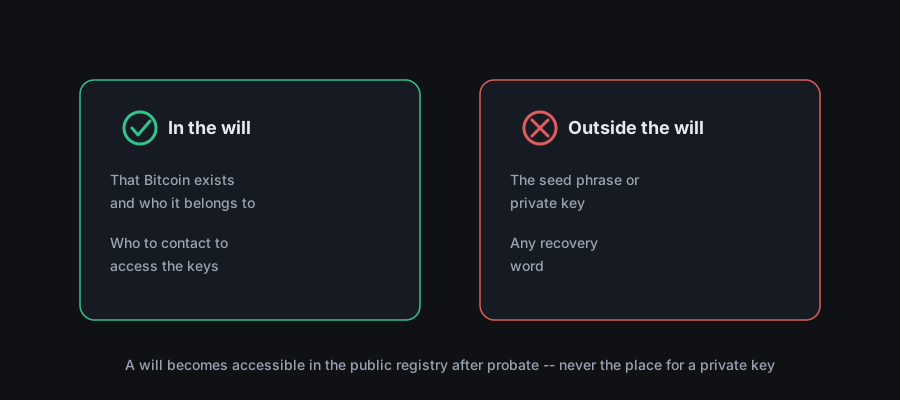
The natural reaction of someone who understands the problem is "I'll just write it all down in my will, so it's clear." That's exactly the mistake to avoid. A will becomes an accessible document in the public registry once probate opens -- anyone with access to that registry (not just your heirs) could potentially see its contents. Writing a 12- or 24-word seed phrase there is publishing the key to your own safe.
What SHOULD go in your will
The solution isn't leaving Bitcoin out of your will -- it's separating two things people tend to mix up: the record that the asset exists (that does go in the will, like any other account or property) and the access mechanism for the private keys (that needs its own channel, outside the will). It's enough for the will to mention that Bitcoin exists, who it belongs to, and who the heir should contact to get access -- without that "who to contact" already being the key itself.
Physical redundancy: the simplest option
The simplest access mechanism is physical redundancy: several copies of your seed phrase kept in different secure locations (a safe, a notary, a trusted family member), so a single incident (fire, theft, loss) doesn't eliminate the only access that existed. The risk with this method is the exact opposite of the will problem: if there's only one copy in a single place, one mishap destroys it forever; if there are too many copies spread around without control, it increases your exposure. The right balance depends on how much you hold and who you trust.
Multisig: splitting trust across several keys
A multisig scheme splits control across several keys instead of relying on one. In a 2-of-3 setup, none of the three parties alone -- not you, not your heir, not a trusted third party -- can move the funds; at least two signatures are always required. This solves the physical-redundancy problem (no single intact copy needed) without creating a single point of failure or theft: if one of the three keys is lost or compromised, the other two are still enough. The cost is setup complexity: it requires more technical knowledge than a regular wallet, both from you and, ideally, from your heir.
Digital inheritance services and timelock
Two more automated mechanisms exist. Digital inheritance services (sometimes described as a "dead man's switch") periodically check that you're still active and, if you stop responding for a defined period, grant access to whoever you designated -- without depending on anyone discovering your death through some other channel. Timelock does something similar directly on the blockchain: a transaction set up so an heir can only claim the funds after a period of inactivity from the original owner, without depending on any external service. Neither option is universally "correct" -- they're tools with different tradeoffs, not automatic substitutes for thinking the problem through.
Checklist before assuming this is handled
- Inventory of where you hold Bitcoin (which wallets, which exchanges, which hardware wallets).
- A document an heir can find, mentioning that it exists and who it belongs to -- with no key inside it.
- A real access mechanism (redundancy, multisig, digital inheritance service, or timelock) chosen and already set up, not just decided verbally.
- Your will reviewed by a notary who knows digital assets are involved.
- A periodic review: if you switch wallets or custodians, the previous mechanism stops working unless it's updated along with it.
Before deciding which succession mechanism fits you, it helps to know exactly what's in your addresses. You can analyze any of yours with the address analyzer.
Last updated: 2026-07-15