
Bitcoin Custody in Spain: Self-Custody, Exchange, or Institutional, Compared Without Hype
Keeping your Bitcoin on a hardware wallet, on an exchange, or with an institutional custodian aren't three variants of the same thing -- they're three different trust relationships, with different tradeoffs. Here's how they compare, without naming brands and without recommending any.
This comparison deliberately doesn't name specific companies: an exchange's or custodian's conditions change over time (fees, coverage, even their solvency), and stating something true today that might stop being true tomorrow doesn't fit how we want to do things. What does stay stable are each category's structural properties -- and those are the ones that actually matter when deciding.
Three ways to hold Bitcoin, one underlying question
Self-custody: full control, full responsibility
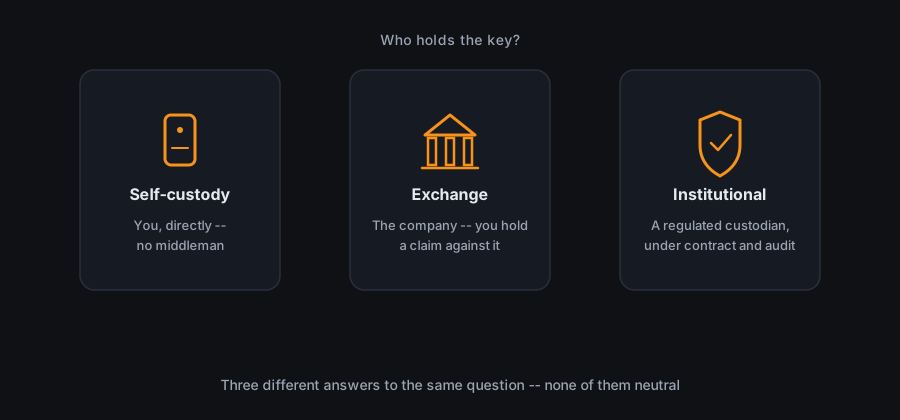
With a hardware or software wallet where you generate and keep the seed phrase, no one but you can authorize a movement of those funds -- not a company that goes bankrupt, not a government, not a hacker who doesn't have your physical key. The tradeoff is that there's no one to call if you lose that key either: there's no support desk that can recover it for you. It's the option with the most control and the most personal responsibility, with no middle ground.
Centralized exchange: convenience in exchange for trust
A centralized exchange holds the keys for you. While your Bitcoin is there, it isn't technically yours in the sense that matters: it's an entry in another company's database, and you hold a claim to it, not direct ownership. It's convenient -- no keys to manage, and it makes buying/selling fast -- but that claim depends on the company staying solvent, not getting hacked, and letting you withdraw whenever you want. It's the crypto version of keeping money in a bank: practical, with a real counterparty risk that doesn't disappear just because you don't think about it.
Institutional custody: the middle ground for large holdings
An institutional custodian professionalizes the same trust relationship that already exists with an exchange: a formal contract, periodic audits, and often asset segregation (your funds identified separately from the company's own, not pooled together). It doesn't eliminate counterparty risk -- it's still not self-custody -- but it reduces it and makes it more verifiable. It mostly makes sense for large holdings, companies, or funds that need that formal framework more than the simplicity of a retail exchange.
What Spanish regulation requires from whoever custodies for you
Since 2021, any provider of virtual currency exchange or electronic wallet custody services operating in Spain must register with the Bank of Spain. It's a real requirement, but it shouldn't be over-read: registration certifies compliance with anti-money-laundering rules, it doesn't guarantee solvency or protect your funds from a hack or mismanagement. Checking that a provider is registered is a reasonable minimum filter, not proof of safety.
What happens with each option if something goes wrong
With self-custody, "something going wrong" depends entirely on you: you lose the key, you expose it, or you die without leaving a succession plan (see the inheritance guide for that last one). With an exchange or custodian, "something going wrong" can depend on the company itself -- insolvency, a hack, withdrawal restrictions -- without you having made any mistake. Neither category of risk is inherently larger than the other in the abstract: they're risks of a different nature, and choosing means choosing which one you'd rather manage yourself.
How each option affects your inheritance plan
Self-custody requires you to have left an explicit access mechanism for your heirs (redundancy, multisig, digital inheritance) or the funds are lost regardless of what your will says -- see the guide dedicated to that. An exchange or institutional custodian, on the other hand, does have a known succession process (similar to a bank account: death certificate, legal documentation) -- at the cost of, once again, depending on that company still existing and cooperating when the time comes.
Which one to choose
There's no single correct answer, and any comparison that tells you otherwise is oversimplifying. A reasonable pattern: the more you hold and the more you know, the more self-custody makes sense; the less technical you are or the more urgent your liquidity needs, the more an exchange makes sense; and for large holdings needing a formal framework, institutional custody. Many people use a combination of all three depending on the purpose of each part of their holdings, not a single option for everything.
Whatever your custody choice, it helps to know exactly what's in the addresses you do control. You can analyze any of them with the address analyzer.
Last updated: 2026-07-15