
What Is DCA in Bitcoin and How Is It Different from Score DCA
DCA means investing a fixed amount at regular intervals instead of all at once. Score DCA is a variant that adjusts that contribution based on the cycle phase. Here we explain both, along with their real advantages and limits.
DCA (Dollar Cost Averaging) means investing a fixed amount at regular intervals -- say, $50 every week -- instead of putting all your money in at once. Its advantage isn't maximizing gains, but eliminating the worst possible decision: going all-in right before a crash. In this article you'll see how it works, when it helps and when it doesn't, and how it differs from Score DCA, the variant that adjusts the contribution based on the cycle.
Starting with the basics: what DCA is
DCA stands for Dollar Cost Averaging. The idea couldn't be simpler: instead of investing all your money at once trying to guess the best moment, you invest a fixed amount at regular intervals -- $50 every week, $200 every month -- no matter what the price is doing.
Why do this? Because nailing the exact entry point is nearly impossible, even for professionals. If you spread your purchases out over time, sometimes you'll buy high and sometimes low, and the average price across all your purchases smooths out. You give up the best possible move -- catching the exact bottom -- in exchange for avoiding the worst one -- putting all your capital in right before a crash. For most people, that trade-off is worth it, especially in an asset as volatile as Bitcoin.
A simple example
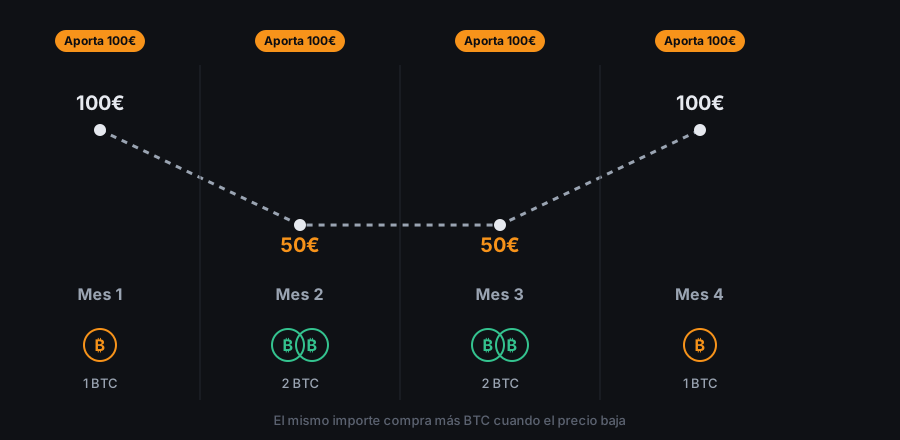
Imagine you decide to invest $100 a month in Bitcoin for four months:
- Month 1: Bitcoin at $100 → you buy 1 BTC
- Month 2: Bitcoin at $50 → you buy 2 BTC
- Month 3: Bitcoin at $50 → you buy 2 BTC
- Month 4: Bitcoin at $100 → you buy 1 BTC
You've invested $400 and hold 6 BTC, so your average purchase price is $66.6 per BTC -- notably better than the initial $100 price, without having to guess anything. Notice the key detail: in the cheap months, that same $100 bought twice as much Bitcoin. DCA automatically makes you buy more when the price drops and less when it rises, without you having to decide anything. That's the entire mechanism.
Advantages and limits of DCA
DCA has clear advantages, but it isn't magic, and it's worth knowing its limits before using it:
Advantages:
- Doesn't require timing the market. You eliminate the stress (and the risk) of trying to time the market, something almost nobody does consistently well.
- Enforces discipline. Contributing automatically and regularly avoids the two most common emotional traps: buying out of euphoria at highs and not buying out of fear at lows.
- Reduces the worst case. Spreading out your entry makes it mathematically impossible to put all your capital in on the worst possible day.
Limits:
- Doesn't maximize returns. In a market that rises steadily over the long term, investing everything upfront (lump sum) tends to beat DCA: the earlier you enter, the longer your money is exposed to the rise. DCA trades potential returns for less risk, not the other way around.
- Doesn't protect against a prolonged bear market. If the price falls for years, continuing to contribute averages your cost down, but your portfolio stays in losses for as long as the drop lasts.
- It's a discipline, not a signal. Traditional DCA doesn't know whether the market is expensive or cheap: it contributes the same amount regardless. That's exactly where the next idea comes in.
What Score DCA is and how it differs
Traditional DCA always invests the same amount, regardless of whether the market is expensive or cheap. Score DCA changes exactly that: instead of always contributing the same, it adjusts how much you invest each period based on the cycle phase marked by the Score.
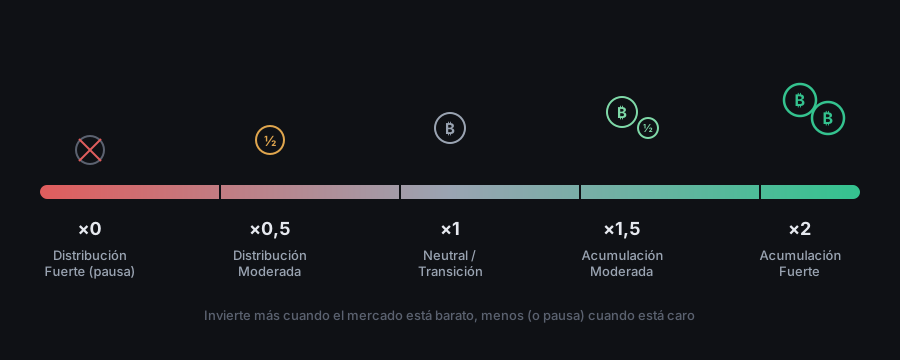
The logic is intuitive: if the Score indicates an accumulation zone (prices historically low relative to the cycle), it makes sense to take advantage and contribute more; if it indicates a distribution zone (prices historically high, more risk), it makes sense to contribute less or pause. In practice, Score DCA multiplies your base contribution according to the phase:
- Strong accumulation: invests double the base contribution.
- Moderate accumulation: invests one and a half times.
- Neutral / transition: invests the normal contribution, same as traditional DCA.
- Moderate distribution: invests half.
- Strong distribution: pauses that period's contribution.
Does the money that isn't invested get lost?
No. When Score DCA contributes less than normal (or pauses), that difference doesn't disappear: it's kept as a reserve and used in addition to the normal contribution during the next accumulation phase. So, over time, all the planned money still ends up invested -- it's just concentrated more in the cheap phases and less in the expensive ones.
An important detail: Score DCA doesn't need to "predict the future" to do this. Each period decides using only the information available that day, just like you would. It's not a trick that only works by looking at the past with an unfair advantage.
An honest warning
At BlockPulse Analytics, Score DCA is a simulator, not a robot that invests for you. What it does is show you, using real historical data, how that strategy would have performed against traditional DCA over the period you choose. It doesn't execute purchases, doesn't manage your money, and isn't an investment recommendation.
And it's honest about its results: it picks the "winner" by annualized return, not by total money invested, and if traditional DCA would have done better over the period you select, it tells you exactly that. The point isn't to sell you on one strategy always winning -- that would be false, and with only a couple of Bitcoin cycles no result is statistically conclusive -- but to let you compare both with the data in front of you and draw your own conclusions.
How to try it
You can use the Score DCA simulator directly in the Market section: choose the time range, the contribution amount, and the frequency (weekly or monthly), and instantly compare how both strategies would have performed using real historical Score data. And if you want to understand where the Score that modulates those contributions comes from -- which indicators make it up and where the data comes from -- you can read our Score methodology, which explains the whole system without hype and with a verifiable track record.
Last updated: 2026-07-09