
Bitcoin as a Retirement Plan: What the Public System Can't Promise You
Spain's public pension system already applies active cuts to anyone retiring early, and depends on demographics that will keep adjusting for decades. Self-custodied Bitcoin doesn't have that same single point of decision -- but it shifts all the responsibility for not losing the key onto you. This is a framework for thinking about the problem, not investment advice.
Nothing that follows is personalized financial or tax advice, and nothing here is a promise about Bitcoin's future returns. It's a different exercise: looking, with verifiable data, at how Spain's public pension system actually works today, why its own demographics force a long-term adjustment, and what an alternative -- saving part of your wealth in an asset no third party can unilaterally recalibrate -- offers, and demands.
The system itself penalizes retiring early
If you retire before the legal age, Social Security applies a permanent reduction coefficient to your pension -- not a one-off discount, but one that follows you for the rest of your life. Under voluntary early retirement, that coefficient ranges from 2.81% to 21% depending on years contributed and months of advance. A concrete case makes it tangible: someone with between 41 years 6 months and 44 years 6 months of contributions who retires 23 months earlier than their standard age loses 15% of their pension permanently. Under involuntary early retirement the cut can reach 30%, though access conditions are somewhat more favorable. These aren't figures from our own calculation: they're the official tables currently in force.
The system's sustainability today: no alarmism, just data
Here it's worth being honest in both directions: Spain does not have a problem of low pensions today. According to the OECD's Pensions at a Glance report, Spain pays a replacement rate (pension relative to final salary) of 80.4%, well above the OECD average of 52%. It is, in fact, one of the most generous in the entire developed world.
The important nuance is whether that generosity is sustainable without changes. Spain's Independent Authority for Fiscal Responsibility (AIReF) confirms that the pension spending rule is being met today, but warns that this compliance is compatible with public debt that would keep growing as the population ages. The correct framing isn't "the pay-as-you-go system is already unsustainable" -- it's that it's generous because the system hasn't yet absorbed the demographic adjustment already visible on the horizon, covered in the next section.
Why the demographic adjustment is inevitable, not an opinion
This doesn't depend on which government runs the system: it's population arithmetic, and the official INE projections come from Spain's own public statistics agency. Today 21.1% of Spain's population is 65 or older; that share could reach a maximum of 30.9% by 2076 if current trends hold. The dependency ratio (population outside working age relative to working-age population) could reach 73.2% that same year.
A less-cited but equally relevant figure: over the next 50 years, Spain will always have more deaths than births -- a sustained negative natural growth rate, not a temporary dip. This isn't pessimism: it's the same source the state itself already uses for planning. As fewer people of contributing age support more retirees for longer (life expectancy at birth in Spain rose from ~80 years in 2000 to 83-84 years today), the pay-as-you-go system's equilibrium point shifts -- not by political decision, but by demographics.
The silent erosion: what happens to your money even if you never touch it
There's a second, quieter problem that has nothing to do with pensions at all: what happens to the value of your savings from the mere passage of time. Spain's cumulative inflation over the last 10 years has been 23.6% -- €1,000 kept idle in 2015 has today the purchasing power of about €809 of that same year, measured in 2025 euros. Zooming out further, the euro has lost more than 40% of its purchasing power since the year 2000, based on estimates drawing on ECB data.
The European Central Bank has a 2% annual inflation target as deliberate policy, not as a system failure -- which means any savings that don't sustainably outpace that figure lose purchasing power structurally, year after year, with no exceptional event required for it to happen.
Unconfiscatability and sovereignty: the central contrast
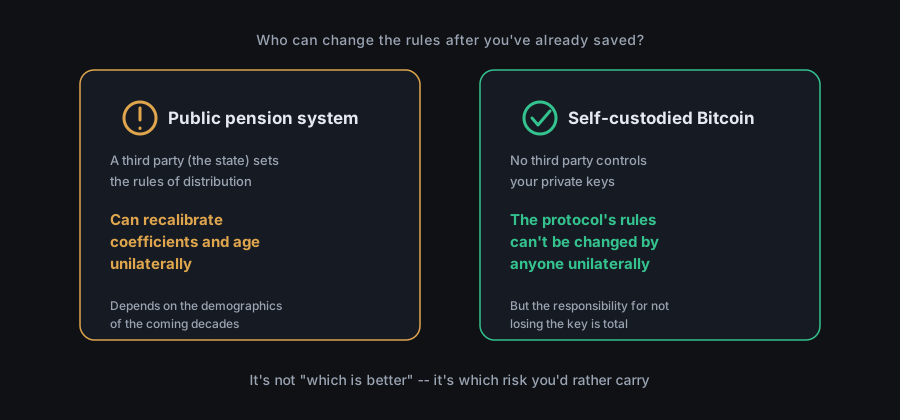
Here's the comparison that actually matters, stated plainly: in the public system, a third party (the state) can unilaterally recalibrate your pension's rules, as the reduction coefficients in the first section already show. With real self-custodied Bitcoin, no third party controls your private keys -- not to recalibrate rules, not to freeze access.
Recent history has concrete examples of what depending on an intermediary under pressure actually means. In Argentina, Decree 1570/2001 (the "Corralito") limited cash withdrawals to 250 pesos/dollars per account holder per week, following a sustained flight of deposits from the banking system. Within the eurozone itself, the 2013 Cyprus bailout imposed a direct haircut on deposits above €100,000 and, for weeks, limited ATM withdrawals to a couple hundred euros a day. Neither case is Bitcoin or has anything to do with Bitcoin -- they're examples that the promise "your money is available when you need it" ultimately depends on the solvency and decisions of a third party under pressure.
The honest counterweight is mandatory, not optional: sovereignty brings total responsibility for private key security. There's no "bank" that rescues a lost seed phrase, and no account-recovery process. If you lose access, you lose it forever -- it's the same property that prevents confiscation that also prevents rescue.
A quantitative comparison, still in progress
It would be natural to expect a direct historical-return comparison here between Bitcoin, a global index fund, an interest-bearing deposit, and a traditional Spanish pension plan, in real (inflation-adjusted) terms and using the same periodic-contribution methodology already used in our Score DCA simulator. That comparison is in progress -- it requires first defining the exact assets and period, and we're not going to present a figure without verifying it with the same walk-forward rigor we already apply to our own Score (see where it's failed). It will be published as an update to this same article once ready, never as a projection of future returns.
From theory to practice: custody
Saving in Bitcoin under this article's logic only makes sense if custody is properly handled -- the protocol's unconfiscatability is of little use if the key is lost or exposed through an avoidable mistake. Our comparison of custody options in Spain explains the real differences between self-custody, exchanges, and institutional custody, and our succession planning guide covers what happens if something happens to you without having left a plan.
A brief tax note, not a substitute for an advisor
Saving in Bitcoin doesn't exempt you from any tax obligation. If you ever sell, swap for another cryptocurrency, or exceed the thresholds for Form 721 with custody abroad, there are specific rules to declare -- covered in detail, including what does NOT apply if you control your own keys, in our guide to Bitcoin taxes in Spain. This note is deliberately brief: for your specific case, the only correct answer comes from a real tax advisor, not an article.
A framework for thinking, not a closed answer
None of this is a prediction that the public pension system will fail, nor a promise that Bitcoin will appreciate in the future. It's simply the acknowledgment of two verifiable facts: the pay-as-you-go system already applies active cuts today and depends on demographics that will keep adjusting for decades, and there exists a savings alternative without that same single point of decision -- in exchange for a responsibility that falls entirely on whoever chooses it. Deciding how much, if anything, to allocate to each is a personal decision that depends on your full situation, and one where qualified financial and tax advice matters more than this article.
This content is informational, not financial or tax advice, and not an investment recommendation. Before deciding anything, you can check the live cycle Score or analyze any of your own addresses with the address analyzer -- free, no sign-up required.
Last updated: 2026-07-16